Holy Fire : Art in the Digital Age

Holy Fire

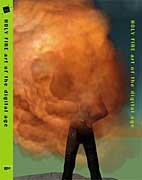
Holy Fire: Art in the Digital Age will present a unique panel of digital artworks created since 2000 by internationaly known media artists. The exhibition will be featured at iMAL new media center in Brussels (www.imal.org/) as part of the “off program” of Art Brussels, the international contemporary art fair ( www.artexis.com/ArtBrussels/, April 18 – 21, 2008).

Holy Fire is probably the first exhibition to show only collectible new media artworks already on the art market, in the form of traditional media (prints, videos, sculptures) or customized new media objects. Holy Fire presents contemporary artworks made with contemporary technologies and designed to be collectible.

Artists: Cory ARCANGEL, Gazira BABELI, BOREDOMRESEARCH, Christophe BRUNO, Grégory CHATONSKY, Miguel CHEVALIER, Vuk COSIC, Shane HOPE, JODI, LAb[au], Joan LEANDRE, Golan LEVIN, Olia LIALINA & Dragan ESPENSCHIED, Eva and Franco MATTES aka 0100101110101101.ORG, Alison MEALEY, Mark NAPIER, Casey REAS, Charles SANDISON, Antoine SCHMITT, Yacine SEBTI, Alexei SHULGIN & Aristarkh CHERNYSHEV, John. F. SIMON, Jr., Paul SLOCUM, Wolfgang STAEHLE, Eddo STERN, UBERMORGEN.COM, Carlo ZANNI.
Dipity : make and share interactive timelines

A timeline is a graphical representation of a chronological sequence of events, also referred to as a chronology. It can also mean a schedule of activities, such as a timetable. The timelines can be drawn or digital-made.

 
Dipity is the easiest way to make and share interactive timelines about the people and things you care about. Created by the start-up Underlying Inc., founded by three long time Internet professionals in april 2007, the first project name T1ME was changed to Dipity (from Serendipity, the effect by which one accidentally discovers something fortunate, especially while looking for something else) in october 2007. Dipity is a fantastic time-line visualization tool which allow you to manage online media by ordering related content chronologically. By using Dipity you can create a stream that allows you to keep track of text,  pictures, videos and blog posts by adding events manually or by adding RSS feeds to automatically create events. Timelines can be embedded in your own website, the content for RSS feeds is generated in realtime. An API to develop online applications to generate events is available for developers.

An example of an embedded timeline to present the exhibitions of Leslie’s Artgallery in Bridel, Luxembourg is shown hereafter :


Dipity streams can be visualized in four views :

  • Timeline : the timeline shows everything that was added to the stream based on the time the item was published. There’s a zoom feature that allows you to zoom in and out of your timeline by day, month, or years. The longer the length of time, the smaller the timeline view will become.
  • List View : a very simple list of events in the stream
  • Flipbook : clicking on the blocks at the bottom of the window allow you to ‘flip’ through the stream.
  • Map View : powered by Google, the map view is a great tool for users that have items that are geo-tagged, or tagged with a location. This is best suited for events that are manually added to a stream rather than by rss feeds. An autoplay event show is integrated in the map view.

Dipity is also a social timeline application for Facebook to allows users “to tell their story” using a visual timeline. Dipity started in march 2008 as an alpha version. In may 2008 Dipity added the first mashup application, TimeTube, to create TubeLines. In june 2008 Tickr! ( = Time + Flickr) was launched as the second mashup application.

42ème foire d’Art contemporain de Cologne

Köln

Art Cologne, la 42ème foire d’Art contemporain de Cologne, a ouvert ses portes du 16 au 20 avril 2008. Daniel Hug, nouveau directeur d’Art Cologne, poursuit une tradition colonnaise de plus de quarante ans de promotion de l’Art contemporain avec 150 galeries représentées sur un site qui l’an passé dépassait les 55’000 mètres carrés. Jeunes artistes et plus anciens seront représentés pour créer un panorama des créations des vingtième et vingt-et-unième siècles.

Voronoi Fractal

A Voronoi diagram is created from a set of points by dividing the plane into regions, where each region consists of the area closest to one of the points. Ken Shirriff published a paper about voronoi fractals ten years ago. Frederik Van Houtte from Belgium created a nice applet with the processing language to generate online voronoi fractals.

Click the applet to generate a new fractal.

A description of the project and the source code are published on Frederiks weblog under a  a Creative Commons license.

There.com : 3D online virtual world

there.com


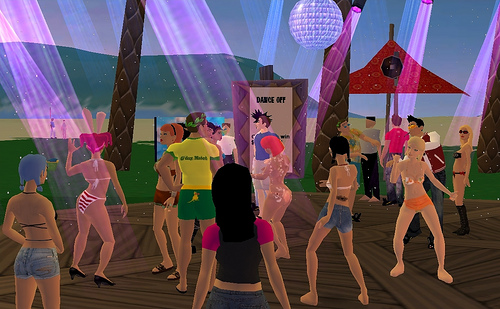
There.com is an online getaway where you can hang out with your friends and meet new ones, all in a lush 3D environment that’s yours to explore and help build. The 3D online virtual world “There” was created by Will Harvey and Jeffrey Ventrella. There Inc. was founded in the spring of 1998. Closed beta began in July of 2001, with various stages of beta following, and ending with an October 2003 launch date. “There.com” went live in 2003 as the first virtual world. It was such a new concept in 1997 that it took a lot of time to build the new 3D technology. In 2004. There changed its name to Forterra to reflect its expanding focus on virtual world technologies for consumer, business and government services.

In April 2005, Makena Technologies, founded by Entrepreneur Michael Wilson, acquired the exclusive license of “There” and the management of the There community from Forterra Systems. Makena Technologies, Inc., a privately held corporation, is headquartered in Silicon Valley, CA. Today, the business model is based on membership fees, on virtual currency for e-commerce and on advertising.

On April 3, 2008, Paramount Pictures announced that  their film vault is opening up in the virtual world “There.com”.